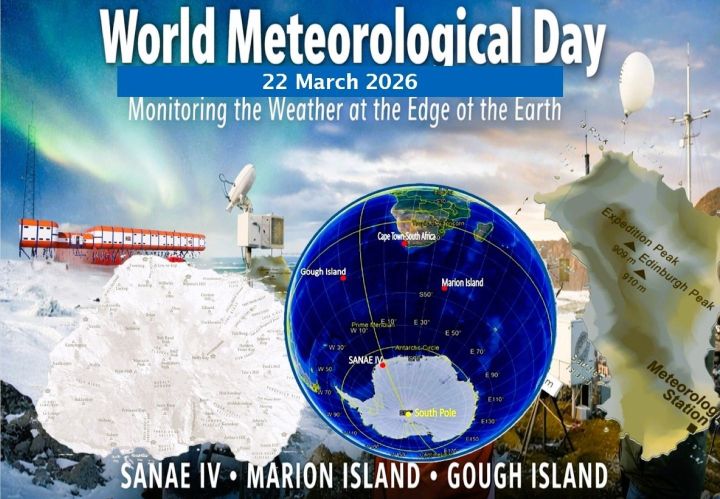
 Each year on 23 March, World Meteorological Day marks the establishment of the World Meteorological Organization in 1950 and celebrates the vital role of meteorology in safeguarding lives and livelihoods. For South Africa, this global effort is strengthened by the work of dedicated meteorologists stationed in some of the most remote environments on Earth—SANAE IV, Marion Island and Gough Island. From these isolated bases, scientists continuously monitor atmospheric conditions, contributing critical data that feeds into both national forecasting systems and global climate models.
At SANAE IV in Antarctica, meteorologists record weather patterns that influence global circulation systems. Meanwhile, at Marion Island and Gough Island, teams track rapidly changing weather in the Southern Ocean and South Atlantic—regions known for their powerful storms and complex climate interactions. Their observations help improve the accuracy of forecasts, support maritime and aviation safety, and deepen our understanding of climate variability. This work ensures that South Africans remain informed and prepared, even when the weather systems affecting them originate thousands of kilometres away.
Beyond daily forecasts, the long-term datasets collected at these stations are essential for detecting climate trends and understanding future risks. By maintaining a continuous presence in these key locations, SANAP contributes to a global network of meteorological observation that underpins climate science and resilience planning. On World Meteorological Day 2026, we recognise the commitment of these teams who, far from home, play a crucial role in keeping South Africa—and the world—connected to the ever-changing atmosphere.
World Meteorological Day 2026: Observing the Skies from Earth’s Southern Frontiers